

Choosing a fence for your home involves more than picking a style you like. The right fence should fit your property, provide the level of privacy or security you need, withstand the local climate, and stay within your budget. Whether you’re enclosing a backyard, protecting children and pets, improving curb appeal, or creating a private outdoor space, the material you choose makes a major difference.
A reliable residential fence company can help you compare materials based on your property’s layout, maintenance requirements, budget, and long-term goals. Among the most popular options, wood, vinyl, aluminum, and chain link each offer different advantages.
So, which one is right for your home? Let’s compare them in detail.
Quick Comparison: Wood vs. Vinyl vs. Aluminum vs. Chain Link
| Feature | Wood | Vinyl | Aluminum | Chain Link |
| Privacy | Excellent | Excellent | Low–Moderate | Low |
| Curb Appeal | Excellent | Excellent | Excellent | Moderate |
| Durability | Good | Excellent | Excellent | Excellent |
| Maintenance | High | Low | Low | Low |
| Security | Good | Good | Good | Excellent |
| Pet-Friendly | Excellent | Excellent | Good | Excellent |
| Design Options | Many | Many | Many | Limited |
| Rust Resistance | N/A | Excellent | Excellent | Good–Excellent |
| Typical Cost | $$ | $$$ | $$$ | $ |
| Best For | Privacy & traditional style | Low-maintenance privacy | Style & durability | Budget & security |
Actual costs vary based on fence height, length, material quality, terrain, gates, labor, permits, and installation requirements.
1. Wood Fencing: Best for Privacy and Traditional Appeal
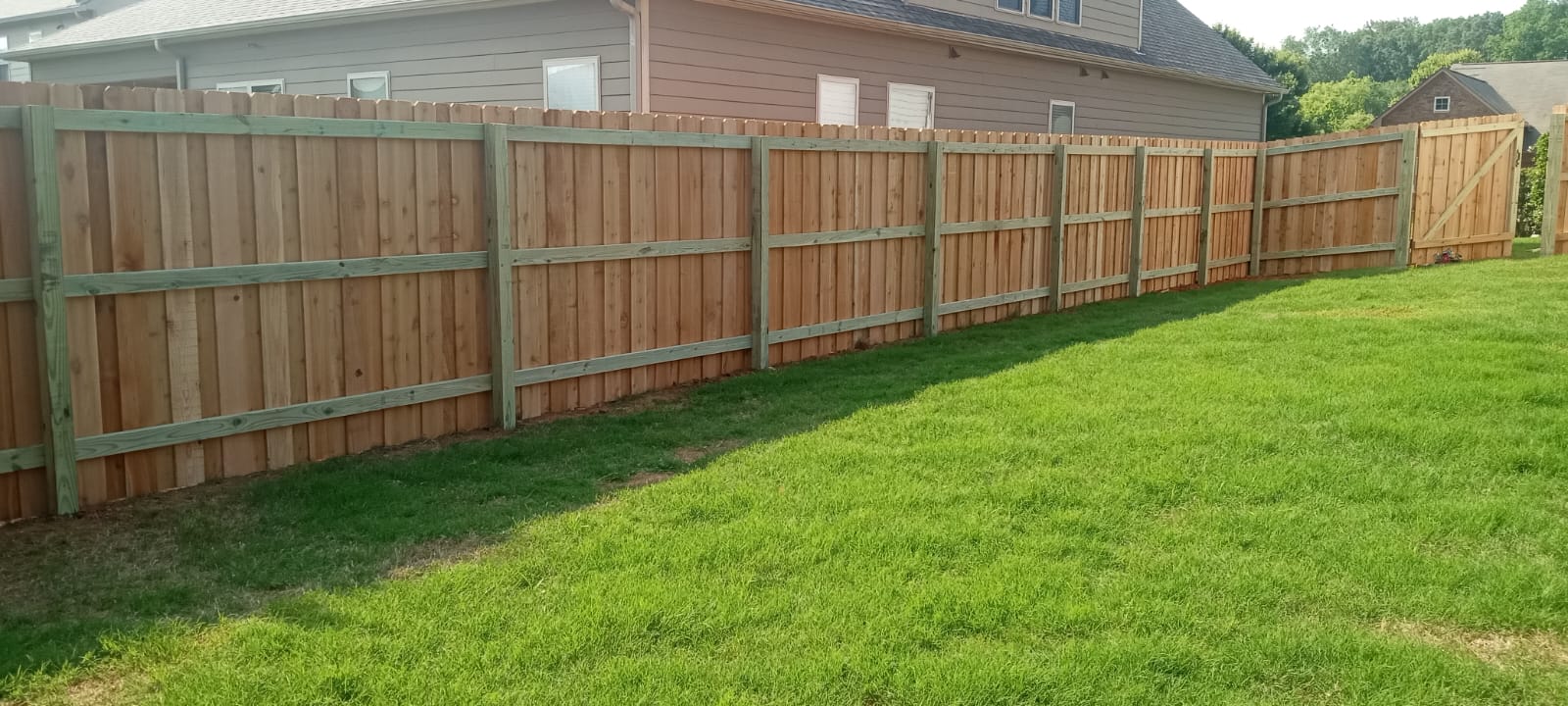
Wood remains one of the most popular residential fencing materials because it offers a classic appearance and tremendous design flexibility.
A wood fence can create a warm, natural appearance that complements traditional, modern, farmhouse, and many other architectural styles.
Advantages of Wood Fencing
Excellent privacy:
Solid wood panels can create a strong visual barrier between your property and neighboring homes.
Flexible design:
You can choose from picket fences, privacy fences, board-on-board designs, horizontal fencing, shadowbox fencing, and other styles.
Natural appearance:
Wood provides a look that manufactured materials may not completely replicate.
Customizable:
Wood can be stained or painted in different colors to coordinate with your home.
Good initial value:
Depending on the type of wood and design, wood can provide an attractive balance between appearance and upfront cost.
Disadvantages of Wood Fencing
The biggest drawback is maintenance.
Wood can be affected by:
- Moisture
- Rot
- Insects
- Mold and mildew
- Sun exposure
- Peeling paint or fading stain
- Warping and cracking
Depending on the material and local conditions, you’ll typically need periodic cleaning, staining, painting, or sealing.
Who Should Choose Wood?
Wood is a strong choice if you prioritize:
- Privacy
- Traditional aesthetics
- Custom designs
- A natural appearance
- The ability to repaint or restain your fence
If you don’t mind ongoing maintenance, wood can be an excellent residential fencing option.
2. Vinyl Fencing: Best for Low-Maintenance Privacy
Vinyl fencing has become increasingly popular among homeowners who want the appearance of a traditional fence without many of the maintenance requirements associated with wood.
Vinyl is particularly appealing for homeowners who want a clean, consistent appearance and don’t want to regularly stain or paint their fence.
Advantages of Vinyl Fencing
Low maintenance:
Vinyl generally doesn’t require regular staining or painting.
Good privacy:
Solid vinyl panels can provide substantial privacy for backyards, patios, and pools.
Moisture resistant:
Vinyl doesn’t rot like wood, making it attractive for areas exposed to moisture.
Consistent appearance:
The material maintains a relatively uniform appearance without the natural variations found in wood.
Easy cleaning:
Many surface-level dirt and stains can be removed with soap, water, or appropriate cleaning solutions.
Disadvantages of Vinyl Fencing
Vinyl isn’t maintenance-free.
It can still become dirty, stained, or discolored over time. It can also become brittle under certain conditions and may be damaged by significant impacts.
Another consideration is appearance. While modern vinyl fencing can look very attractive, homeowners looking for the authentic texture of natural wood may prefer wood instead.
Who Should Choose Vinyl?
Vinyl is ideal if you want:
- Privacy
- Low maintenance
- A clean appearance
- Resistance to rot and moisture
- A long-lasting residential fence
It’s particularly suitable for homeowners who want to install a fence and minimize the amount of routine upkeep required.
3. Aluminum Fencing: Best for Style and Durability
Aluminum fencing is an excellent choice for homeowners who want an elegant appearance combined with durability and relatively low maintenance.
Aluminum fencing often resembles traditional wrought iron fencing while offering a lighter-weight and generally lower-maintenance alternative.
Advantages of Aluminum Fencing
Elegant appearance:
Aluminum fencing can provide a sophisticated look that works particularly well around front yards, gardens, pools, and landscaped areas.
Low maintenance:
It generally doesn’t require the same staining or painting routine associated with wood.
Corrosion resistance:
Aluminum doesn’t rust in the same way that conventional iron or steel can, making it useful in areas where moisture exposure is a concern.
Long lifespan:
Quality aluminum fencing can provide many years of service when properly installed and maintained.
Visibility:
Its open design allows homeowners to maintain visibility across the property.
Disadvantages of Aluminum Fencing
The biggest limitation is privacy.
Most aluminum fences use open pickets, meaning they create a boundary without completely blocking views.
Aluminum may also not be the best choice where maximum impact resistance or heavy-duty security is the primary goal.
Who Should Choose Aluminum?
Aluminum is a good choice if you prioritize:
- Elegant appearance
- Low maintenance
- Durability
- Visibility
- Landscaping aesthetics
- Pool-area fencing
It’s particularly effective when you want to define a property without making the yard feel enclosed.
4. Chain Link Fencing: Best for Budget and Practicality
Chain link fencing is one of the most practical residential fencing options. It is widely used when homeowners prioritize functionality, affordability, security, and visibility.
Although chain link isn’t usually the first choice for homeowners focused primarily on aesthetics or privacy, it can be extremely practical.
Advantages of Chain Link Fencing
Cost-effective:
Chain link is often one of the more economical fencing options.
Durable:
Quality chain link can withstand everyday outdoor conditions and is well suited to many residential applications.
Low maintenance:
It doesn’t require the regular painting, staining, or sealing associated with wood.
Excellent visibility:
You can see through the fence, which can be useful for monitoring children, pets, or property.
Pet-friendly:
Chain link is commonly used to create enclosed areas for dogs and other pets.
Fast installation:
Its relatively straightforward construction can make installation efficient, depending on site conditions.
Disadvantages of Chain Link Fencing
The biggest disadvantage is privacy.
A standard chain link fence provides little visual obstruction. However, homeowners can add privacy slats, windscreens, landscaping, or other screening solutions to increase privacy.
Chain link may also offer less curb appeal than decorative wood, vinyl, or aluminum fencing.
Who Should Choose Chain Link?
Chain link is worth considering if you prioritize:
- Affordability
- Security
- Pet containment
- Visibility
- Low maintenance
- Functional property boundaries
Wood vs. Vinyl: Which Is Better for Privacy?
If privacy is your main objective, both wood and vinyl deserve serious consideration.
Choose wood if you want:
- A natural appearance
- More customization
- Traditional character
- The option to stain or paint the fence
Choose vinyl if you want:
- Low maintenance
- Consistent appearance
- Moisture resistance
- Long-term privacy with less upkeep
The decision often comes down to whether you value natural aesthetics and customization or low maintenance and consistency.
Aluminum vs. Chain Link: Which Is Better for Security?
Both materials can be useful for establishing a secure boundary, but they serve different purposes.
Aluminum is often chosen when homeowners want security combined with decorative appeal. Its open design makes it easy to see across the property.
Chain link is more utilitarian and is especially useful for keeping children and pets within designated areas.
For a front yard where appearance matters, aluminum may be more attractive. For a backyard where functionality and budget are priorities, chain link may be the better fit.
Which Fence Requires the Least Maintenance?
If minimizing maintenance is your priority, vinyl and aluminum generally have an advantage over wood.
Wood typically requires more ongoing attention because it can be affected by moisture, insects, weather exposure, and surface deterioration.
Vinyl doesn’t require routine painting or staining, although it should still be cleaned when necessary.
Aluminum generally requires relatively little maintenance beyond keeping it clean and checking for damage.
Chain link is also relatively low maintenance, although components should be inspected periodically for corrosion, damage, or loose sections.
Which Fence Is Best for Pets?
Your pet’s size, behavior, and ability to climb or dig should influence your choice.
Wood
A solid wood privacy fence can be excellent for dogs because it blocks visual distractions and creates a secure enclosure.
Vinyl
Vinyl privacy fencing can provide similar benefits while requiring less routine maintenance.
Aluminum
Aluminum works well for many pets, but its open design means dogs can see through it. For highly reactive pets, that visibility may be a consideration.
Chain Link
Chain link is one of the most commonly used options for pet containment. Its open design provides visibility while creating a physical boundary.
For pets that dig, the fence design and installation details are just as important as the fencing material itself.
Which Fence Is Best for Privacy?
If privacy is your top priority, consider these options:
- Wood privacy fence – Excellent privacy and customizable appearance.
- Vinyl privacy fence – Excellent privacy with lower maintenance.
- Chain link with privacy screening – Can provide additional privacy while retaining chain link’s functionality.
- Aluminum fence – Generally better for defining boundaries than creating complete visual privacy.
For a backyard where you want to relax without seeing neighboring properties, a solid wood or vinyl fence will generally be the most appropriate choice.
What About Fence Maintenance?
Before choosing a fence, think beyond installation day.
A fence is a long-term investment, so consider the amount of time and money you’re willing to spend maintaining it.
Wood Maintenance
Expect to periodically inspect, clean, stain, paint, or seal the fence depending on its condition and material.
Vinyl Maintenance
Routine cleaning is generally the primary requirement.
Aluminum Maintenance
Occasional cleaning and inspections are usually sufficient.
Chain Link Maintenance
Inspect for loose sections, damaged areas, corrosion, and issues with posts or gates.
A slightly more expensive fence with lower maintenance requirements may ultimately be more convenient than a cheaper fence that requires frequent upkeep.
How Much Does a Residential Fence Cost?
There isn’t one universal price for a residential fence.
Your total project cost can depend on:
- Fence material
- Fence height
- Total linear footage
- Fence style
- Number of gates
- Gate size
- Terrain
- Property access
- Existing fence removal
- Post installation requirements
- Labor
- Permits or local requirements
- Custom features
Generally, chain link tends to be among the more budget-friendly options, while premium wood, vinyl, and aluminum designs can have higher upfront costs.
However, installation price alone shouldn’t determine your decision.
Consider the total cost of ownership. A fence that costs less initially but requires frequent maintenance may have different long-term economics than a low-maintenance fence with a higher initial price.
How to Choose the Right Residential Fence for Your Home
Before selecting a material, answer these questions:
1. Why do you need the fence?
Are you looking for:
- Privacy?
- Security?
- Pet containment?
- Child safety?
- Curb appeal?
- Property boundaries?
- Pool enclosure?
- A combination of these?
Your primary purpose should guide your material choice.
2. How much privacy do you need?
For maximum privacy, consider solid wood or vinyl.
For visibility, aluminum or chain link may be better.
3. How much maintenance are you willing to do?
If you don’t want to stain or paint a fence regularly, vinyl, aluminum, or chain link may be preferable.
4. What is your budget?
Compare both the initial installation cost and long-term maintenance requirements.
5. What style matches your home?
Your fence should complement the architecture and landscaping rather than look like an afterthought.
6. Do you need a gate?
Think about pedestrian gates, driveway gates, pool gates, or pet-access gates before finalizing the design.
7. What does your property require?
Slopes, landscaping, existing structures, property lines, drainage, and soil conditions can all influence installation.
Wood vs. Vinyl vs. Aluminum vs. Chain Link: Final Verdict
There isn’t one universally “best” residential fence. The right option depends on what you want your fence to accomplish.
Choose wood if: You want privacy, natural beauty, and extensive customization.
Choose vinyl if: You want privacy with minimal maintenance.
Choose aluminum if: You want an elegant, durable fence with an open design.
Choose chain link if: You want an affordable, practical, low-maintenance boundary for security or pets.
The most important step is to evaluate your property’s needs before choosing a material. A professional fence contractor can help you compare options based on your property’s layout, intended use, budget, and preferred appearance.
Conclusion
Choosing between wood, vinyl, aluminum, and chain link ultimately comes down to balancing privacy, appearance, durability, maintenance, security, and budget. A beautiful fence isn’t necessarily the right fence if it doesn’t meet your property’s practical needs.
If you’re planning a residential fencing project, SuperFenceCo can help you evaluate your options and choose a fencing solution that fits your home’s needs. From traditional wood fencing to low-maintenance vinyl, aluminum, and practical chain link options, working with an experienced fencing professional can make the planning and installation process much easier.