

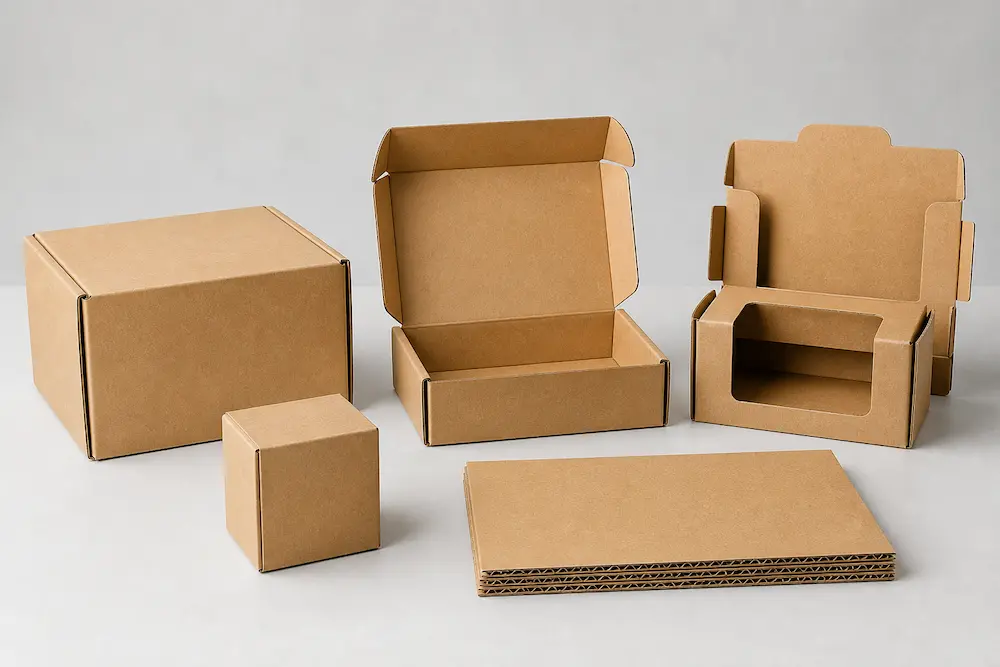
Choosing the right corrugated packaging box is more important than simply finding a container that fits your product. The right box protects merchandise during storage, handling, and shipping while helping control packaging costs, reduce product damage, and create a better customer experience.
With so many box sizes, wall constructions, flute profiles, and strength ratings available, selecting the best option can feel complicated. A box that works well for lightweight clothing may be completely unsuitable for heavy machinery parts or fragile glass products.
This guide explains the key factors businesses should consider when choosing corrugated packaging boxes, from box size and strength to product protection, shipping requirements, and cost.
What Is a Corrugated Packaging Box?
A corrugated packaging box is a shipping or storage container made from corrugated fiberboard. Unlike ordinary paperboard, corrugated material consists of multiple layers designed to provide strength and cushioning.
A typical corrugated box contains:
- Outer liner: The exterior paper layer that provides structure and printability.
- Inner liner: The interior layer that helps support and protect the contents.
- Fluting: The wavy paper layer between the liners that provides cushioning and rigidity.
The combination of these layers makes corrugated boxes suitable for everything from retail packaging and e-commerce shipments to industrial applications.
Why Does Choosing the Right Box Matter?
The box you select can affect nearly every stage of your packaging operation.
1. It protects your products
A properly sized and sufficiently strong box can help protect products from impacts, compression, vibration, and handling during transportation.
2. It can reduce shipping damage
A box that is too weak may collapse under pressure, while one that is too large can allow products to move around inside. Both situations can increase the risk of damage.
3. It can control packaging costs
Using an oversized box increases material usage and may require additional void fill. It can also increase shipping costs when carriers calculate charges based on dimensional weight.
4. It improves operational efficiency
Standardized box sizes can make packing, storage, labeling, and inventory management easier.
5. It supports a better customer experience
A package that arrives intact and appropriately packed creates a more professional impression than one that is crushed, excessively oversized, or poorly protected.
1. Start With Your Product
Before choosing a box, understand exactly what you’re packaging.
Consider:
- Product dimensions
- Product weight
- Product shape
- Fragility
- Surface finish
- Number of items per box
- Whether the product has sharp edges
- Whether the product requires additional cushioning
- Whether the product needs protection from moisture or other environmental conditions
For example, a lightweight T-shirt requires very different packaging from a set of ceramic mugs.
The product should determine the packaging—not the other way around.
2. Measure Your Product Correctly
One of the most common packaging mistakes is choosing a box based on approximate dimensions.
Measure the product’s:
- Length
- Width
- Height
Then determine how much additional space is needed for protective packaging.
If you’re using bubble wrap, foam, paper, or another cushioning material, account for its thickness when calculating the required interior dimensions.
Why internal dimensions matter
A box that exactly matches your product dimensions may not leave enough room for protective material.
On the other hand, a box that is significantly larger than the product creates unnecessary empty space.
Ideally, your packaging should provide enough room for:
Product + protective material + secure closure
without leaving excessive unused space.
3. Choose the Appropriate Box Size
Box size is one of the most important factors in packaging efficiency.
A box that is too small can:
- Compress the product
- Damage corners or edges
- Make packing difficult
- Put pressure on seams
- Prevent proper closure
A box that is too large can:
- Require more void fill
- Increase material costs
- Increase storage requirements
- Allow products to move during transportation
- Potentially increase dimensional shipping costs
Use right-sized packaging
Right-sized packaging doesn’t necessarily mean choosing the smallest possible box. Instead, select a box that provides adequate protection with minimal unnecessary space.
For businesses shipping hundreds or thousands of packages each month, even a small reduction in packaging size can create meaningful savings.
4. Understand Corrugated Box Wall Construction
Corrugated boxes are available in different wall constructions. The most common options include single-wall, double-wall, and triple-wall designs.
Single-Wall Corrugated Boxes
Single-wall boxes typically contain one layer of fluting between two liners.
They are commonly used for:
- Lightweight products
- General e-commerce shipments
- Clothing
- Household goods
- Books
- Smaller retail products
They offer a good balance between protection, weight, and cost for many everyday applications.
Double-Wall Corrugated Boxes
Double-wall boxes contain two layers of corrugated fluting.
They generally provide greater rigidity and stacking strength than single-wall boxes.
They can be appropriate for:
- Heavy products
- Fragile items
- Long-distance shipping
- Products requiring additional protection
- Items that will be stacked during transportation or storage
Triple-Wall Corrugated Boxes
Triple-wall construction provides an even higher level of strength and protection.
These boxes are typically used for demanding industrial and heavy-duty applications where standard single-wall packaging isn’t sufficient.
Which construction should you choose?
Don’t automatically choose the strongest box available.
Instead, match the box construction to the product’s weight, fragility, shipping conditions, stacking requirements, and handling environment.
Using a triple-wall box for a lightweight product could simply increase packaging costs without providing meaningful additional benefits.
5. Understand Box Flute Types
The fluting inside corrugated material also affects box performance.
Different flute profiles provide different combinations of cushioning, rigidity, compression strength, and printability.
Common flute types include:
| Flute | General Characteristics | Common Applications |
| A flute | Thicker cushioning and strong compression | Fragile products, protective packaging |
| B flute | Good puncture resistance and relatively compact | Retail and shipping applications |
| C flute | Balanced cushioning and strength | General shipping boxes |
| E flute | Thin profile and good print surface | Retail packaging, smaller products |
| F flute | Very fine profile | Lightweight retail and presentation packaging |
The right flute depends on the application.
For example, businesses focused on product presentation may prefer finer fluting, while products requiring greater cushioning may benefit from a thicker profile.
6. Consider Box Strength
Box strength is especially important when shipping heavy products or packages that will be stacked.
Two common measurements you’ll encounter are ECT and burst strength.
What Is ECT?
ECT stands for Edge Crush Test.
It measures the amount of force a corrugated board sample can withstand when compressed on its edge.
ECT ratings are commonly associated with a box’s stacking performance.
If your boxes will be stacked in a warehouse, truck, or distribution center, ECT can be an important specification to consider.
What Is Burst Strength?
Burst strength measures the force required to puncture or rupture the corrugated material.
It provides an indication of the material’s resistance to bursting under pressure.
ECT vs. burst strength
Neither measurement is universally “better.”
The appropriate specification depends on your packaging requirements.
If stacking strength is a major concern, ECT may be particularly relevant. If resistance to puncture or bursting is more important, burst strength may be a useful consideration.
7. Consider the Product’s Weight
Product weight should directly influence your box selection.
A lightweight product may require only standard single-wall packaging, while heavier products may require stronger construction.
When evaluating box strength, consider not only the weight of the product but also:
- Weight of the packaging
- Number of products inside
- Stacking conditions
- Shipping distance
- Handling frequency
- Storage conditions
For particularly heavy shipments, don’t rely solely on the box’s dimensions. The box must be capable of handling the total load safely.
8. Think About Fragility
Not every product needs the same level of protection.
Fragile products may require:
- Bubble wrap
- Foam inserts
- Paper cushioning
- Corner protection
- Dividers
- Custom inserts
For example, a business shipping glassware may need a strong box combined with internal dividers and cushioning.
A stronger corrugated box alone doesn’t necessarily eliminate the need for internal protection.
Follow the two-layer protection approach
Think about packaging as two separate systems:
Outer protection: The corrugated box protects against external forces.
Inner protection: Cushioning and inserts prevent the product from moving and absorbing impacts.
Both should work together.
9. Consider How the Box Will Be Shipped
Your distribution method can influence your box selection.
Ask:
- Will the package be shipped through parcel carriers?
- Will it be transported on pallets?
- Will it be moved through a fulfillment center?
- Will it be stored for a long period?
- Will it be shipped internationally?
- Will it experience multiple handling points?
A package moving through several distribution centers may experience more handling than one delivered locally.
For e-commerce businesses, packaging may pass through sorting facilities, delivery vehicles, warehouses, and multiple handling stages before reaching the customer.
That makes box strength and internal product protection especially important.
10. Pay Attention to Dimensional Weight
Box dimensions can affect shipping costs, particularly for lightweight products.
Many carriers calculate shipping charges using dimensional weight when a package takes up significant space relative to its actual weight.
This means an oversized box can cost more to ship even when the product itself is lightweight.
How to reduce unnecessary dimensional weight
You can potentially reduce costs by:
- Using appropriately sized boxes
- Eliminating unnecessary empty space
- Improving product-to-box fit
- Reviewing your most frequently used box sizes
- Standardizing packaging where practical
However, don’t reduce box size so aggressively that product protection suffers.
The goal is optimization, not simply using the smallest box.
11. Consider Your Storage Space
Packaging decisions don’t only affect shipping.
Boxes also need to be stored before use.
Oversized or excessive box inventories can consume valuable warehouse space.
When selecting packaging sizes, consider:
- How many box sizes you actually need
- How frequently each size is used
- How boxes will be stacked
- Available storage space
- Whether flat-packed boxes can be stored efficiently
Businesses can often simplify operations by identifying their most common product dimensions and selecting a practical range of box sizes.
12. Evaluate Your Packing Process
Think about the people and processes involved in packing your products.
If employees spend significant time searching for the correct box or filling excessive empty space, your packaging system may not be optimized.
A good packaging strategy should make it easy to answer:
Which box should I use for this product?
Creating a simple packaging matrix can help.
For example:
| Product Type | Recommended Box Approach |
| Small lightweight items | Small single-wall box |
| Multiple retail products | Medium-sized shipping box |
| Fragile products | Strong box + cushioning |
| Heavy products | Higher-strength construction |
| Large lightweight products | Right-sized larger box |
| Industrial/heavy products | Double- or triple-wall construction |
13. Think About Sustainability
Packaging sustainability is increasingly important to businesses and customers.
Corrugated fiberboard is widely used because it can be recycled through established paper and cardboard recycling systems where appropriate facilities exist.
Businesses can improve packaging efficiency by:
- Right-sizing boxes
- Reducing unnecessary void fill
- Avoiding excessive packaging
- Selecting recyclable packaging materials
- Consolidating shipments when practical
- Using packaging efficiently
However, reducing material shouldn’t come at the expense of product protection.
A damaged product may require replacement, return shipping, and additional packaging—creating more waste and expense.
14. Consider Branding Requirements
Your packaging can also serve a marketing purpose.
Depending on your business, you may want:
- Printed logos
- Brand colors
- Product information
- Handling instructions
- Shipping labels
- Promotional messaging
For businesses using plain stock boxes, branded tape, labels, inserts, or stickers can provide a more customized appearance without requiring fully printed boxes.
For high-volume businesses, custom printed corrugated packaging may be worth evaluating.
15. Compare Total Packaging Cost—not Just Box Price
The cheapest box isn’t necessarily the cheapest packaging solution.
Consider the total cost of packaging, including:
- Box price
- Protective materials
- Tape
- Labels
- Labor
- Storage
- Shipping
- Product damage
- Returns
- Replacement costs
For example, saving a few cents per box isn’t worthwhile if the cheaper box leads to a significant increase in damaged shipments.
A better calculation
Think in terms of:
Total packaging cost = materials + labor + shipping impact + damage/return costs
This gives you a more realistic picture of packaging performance.
16. Test Boxes Before Buying in Bulk
Before committing to a large order, test your chosen box.
Pack the product exactly as it would be shipped to customers.
Then evaluate:
- Does the product fit correctly?
- Is there enough cushioning?
- Does the box close properly?
- Are seams secure?
- Can the package withstand stacking?
- Is the box easy for employees to assemble?
- Is excessive void fill required?
- Does the final package meet carrier requirements?
For valuable or fragile products, more extensive packaging testing may be worthwhile.
Common Mistakes Businesses Make When Choosing Corrugated Boxes
Choosing Based Only on Price
The cheapest box may not offer adequate protection.
Using the Same Box for Every Product
Different products have different packaging requirements. Standardization can help, but forcing every product into one box size isn’t always efficient.
Using Oversized Boxes
Extra space can increase material usage, void fill, and shipping costs.
Ignoring Product Weight
A box suitable for lightweight products may fail when used for heavy merchandise.
Choosing Strength Without Considering the Application
The strongest box isn’t automatically the best box. Packaging should be matched to the product and shipping environment.
Skipping Packaging Tests
A box that looks appropriate on paper may perform differently during real-world handling.
Quick Checklist for Choosing the Right Corrugated Packaging Box
Before ordering your boxes, consider these questions:
- What are the product’s exact dimensions?
- What is the product’s total weight?
- Is the product fragile?
- Does it require internal cushioning?
- How much empty space is necessary?
- Will the package be stacked?
- How far will it travel?
- What shipping method will be used?
- Is single-wall construction sufficient?
- Would double-wall construction provide better protection?
- What ECT or burst-strength rating is appropriate?
- Could box dimensions affect shipping costs?
- How much warehouse space will the boxes require?
- Can the packaging process be standardized?
- Does the box support your sustainability goals?
- Does the packaging need branding?
- Have you tested the box before ordering in bulk?
Final Thoughts
Choosing the right corrugated packaging box requires more than matching a box to your product’s dimensions. You need to consider product weight, fragility, box construction, flute type, strength rating, shipping conditions, storage, packaging costs, and customer experience.
The best packaging solution is one that provides sufficient protection without unnecessary material, space, or expense. Start by understanding your products, measure them accurately, evaluate the shipping environment, and test your packaging before making a large purchase.
For businesses looking for reliable packaging supplies and a range of shipping box options, Starboxes can be a useful resource for finding packaging solutions suited to different shipping and business needs.